Meta + T-Mobile eSIM Trial
Role
Product Designer and Content Lead
Team
2 Product Designers, 1 UX Researcher, 2 Engineers, 1 Product Manager
Timeframe
1 year
Company
Meta & T-Mobile

Overview
Meta partnered with T-Mobile to launch an eSIM trial experience triggered directly from a Facebook feed advertisement. The feature allows users to instantly test-drive T-Mobile’s network on their existing devices without swapping physical SIM cards. By capturing users during the initial awareness phase, this frictionless digital onboarding streamlines the traditional carrier-switching lifecycle and eliminates major technical barriers to activation.
What is eSIM?
An eSIM is a digital version of a physical SIM card. It identifies a device virtually to provide network connection. It’s programmable remotely via software and is built into newer smartphones, meaning users won’t have to go purchase a new SIM card at a store or wait to receive one in the mail if they want to swap phones or wireless carriers.
Why are our partners interested in eSIM?
Trial programs are an emerging acquisition channel enabled by eSIM. They allow users to seamlessly experience the carrier network for a limited time before switching without any commitment. TMO is the most advanced North American operator with regards to eSIM and is currently running a campaign using Meta ads as the main method to obtain new customers.
The eSIM opportunity.
In the US, eSIM device penetration has reached 60% and is expected to significantly increase as iPhone 14 and future iPhone models will support eSIM only. This tech trend enables operators to explore new fully digital acquisition experiences, eliminating the need to visit a physical store or waiting for a SIM card in the mail.
What value does Meta add?
We are collaborating with TMO as a design partner to develop a native experience for the eSIM trial, with the core assumption that eliminating the app download from the funnel will improve its performance and therefore cost-per trial activation.
Strategy
What success looks like for the different stakeholders…
Meta
Becomes the main eSIM acquisition channel for Telcos in North America changing the Give-get equation with partners and unlocking major revenue opportunities.
Telcos
Experience digital transformation. A significant part of their acquisition will be moved online and it will unlock additional use cases such as upgrades, cross selling and support.
Users
Enjoy a trustworthy and seamless digital carrier switch experience with no need to go to a physical store.
How will we do it?
Close collaboration with TMO as a design partner, starting from the ‘Trial program’ use-case. We will take a phased approach to prove different parts of our hypothesis, our top-line metric will be CAC (from ad to carrier switch).

The existing T-Mobile app is already getting good results, so improving upon the current conversion will be a challenge.
#1
largest eSIM campaign
4K
New users a day
17%
switch to T-Mobile
$1.25M
Additional partner ad spend
Customer Journey
Using Facebook ads based on proprietary data we came up with a 4 step journey that served to expedite sign-up for users.
Attract
Highly targeted ads based on device type, tenure and propensity to churn.
Education
Information about the offer to inform and develop trust and confidence in the offer.
Collect
Minimize the amount of information collected by pre-populating data.
Activate
Complete the process and start the network trial without leaving the app.
10 Minutes from Ad to Activation
Design
The eSIM trial
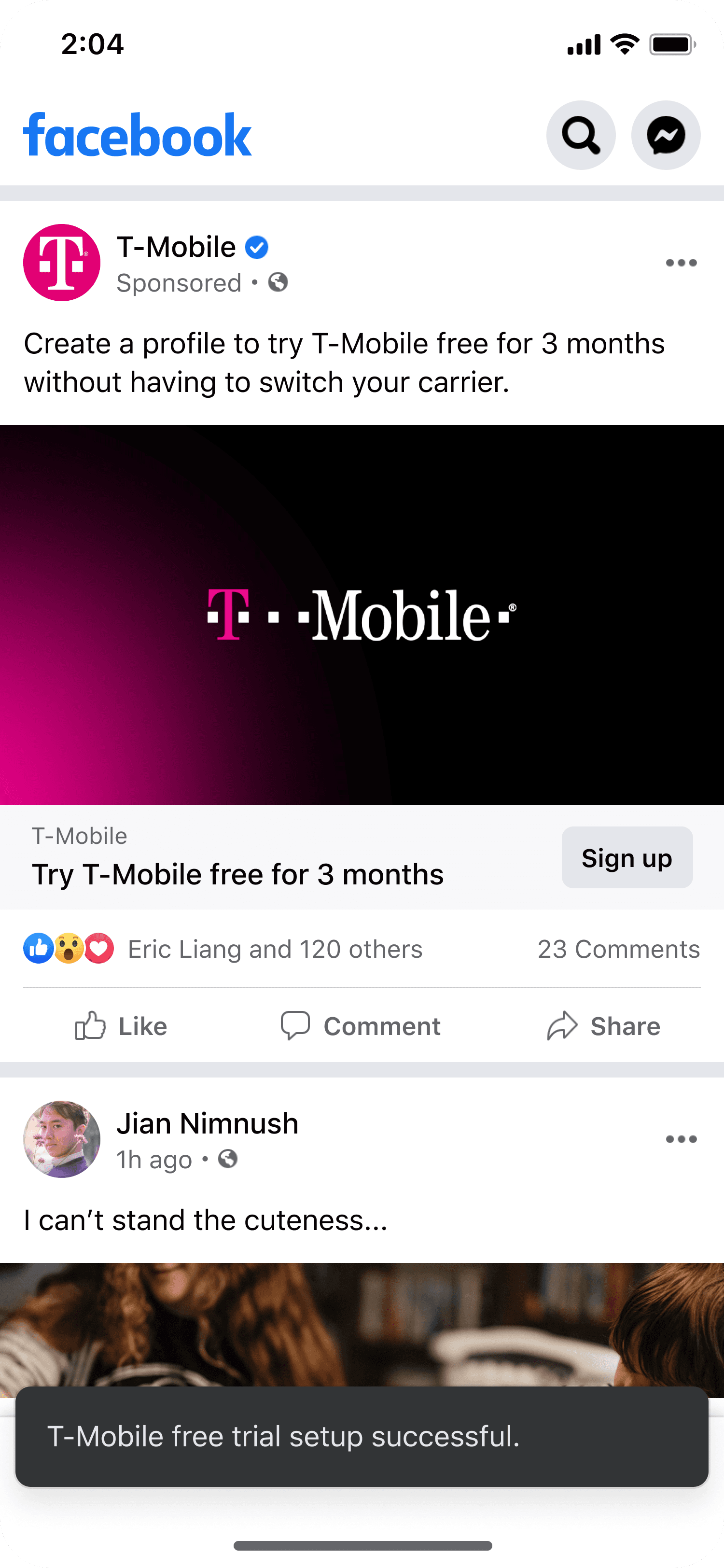
The entry point for this flow is a T-Mobile ad that appears on the user’s newsfeed. It encourages the user to try T-Mobile free for 3 months without having to switch their current phone carrier. Once the user clicks “sign-up” they are brought to a welcome page where we outline the benefits of the free trial. If the user clicks continue they will be brought to a form where they fill out their account and contact information.


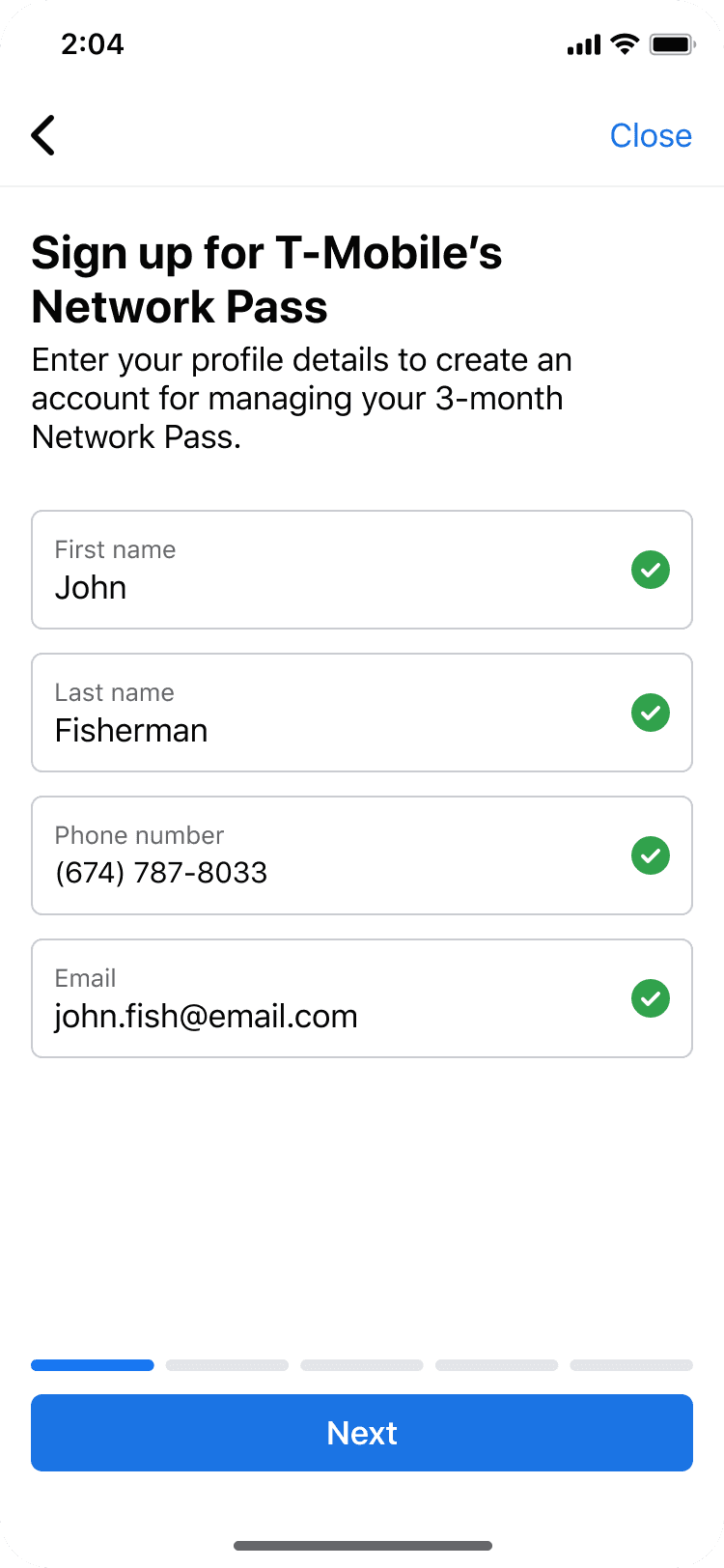
After confirming their details users will check their phone’s compatibility with T-Mobile’s network by entering the IMEI number associated with their Available SIM.


If the user’s phone is compatible they will be brought to the next screen which contains a “How to” video which details the process of installing a new plan using eSIM. After watching the video, the user will receive a push notification that once pressed will open their iOS settings where they can complete the steps outlined in the video. If setup is successful, users will be brought back to their newsfeed and will receive a toast.


In addition to designing the flow, I also was responsible for writing the script and leading the production for the tutorial video which can be viewed below. We created two versions one in English and one in Spanish.
Prototype
Try out the eSIM Trial
If you would like to try out the Meta and T-Mobile eSIM trial tap the link below.
eSIM Trial Prototype ↗
User Research
The Carrier Monetization team needs to grow its revenue for carriers globally in order to maintain high-risk carrier relationships. One part of their strategy is to branch into postpaid developed markets like the US and EU. The team’s strategy in these developed markets is to enter the market with high value scenarios, starting with user acquisition via eSIMs (digital SIM cards), and growing the program to a meaningful portion of telcos’ digital acquisition spend.
The team already has momentum with their eSIM product line, working with large carriers like T-Mobile, Verizon etc. They are currently expanding to a new eSIM use case called “direct switch” which will allow users to switch to a new carrier in a few clicks from a FB ad. This will be piloted with T-Mobile in the US.
As this is a new digital method for carrier switching that does not exist in the market today, the team needs to understand how to best encourage users to engage with this kind of direct switch flow and successfully complete it.
Therefore, we conducted this qualitative research in the US, in order to understand how we should build the direct switch flow for eSIMs, to best encourage users to start and successfully complete it.
Interviews
11 in-depth interviews and iterative design explorations with FB users in New York, in-person in the Meta labs.
Research Qualifications
• Participants previously used a variety of carriers
• All used FB in the month prior to the UXR
• All have a credit card
• All use an iPhone
• Age breakdown:
• 5 young adults (18-29 years old)
• 6 older adults (30 years old and above)
Experience Switching Carriers
• 7 have switched carriers in the past
• 4 who haven’t switched carriers in the past
Type of Carrier Account
• 3 with independent accounts
• 8 with family plans
• 6 are the account owners
• 2 are not account owners, but are involved in plan decision-making
Example Research Questions
• What are contributing factors involved in decision-making when it comes to carrier switching?
• How do users feel about switching carriers online and using eSIM?
• What is your reaction to the direct switch product on FB?
• What are the main barriers to completing the flow?
• How do you feel about setting up eSIM on your own?
Quote 1
“Switching took me about a month. I worried about the hassle of it all. I remember you had to change phone numbers. The fear of switching was worse than what it actually was.”
— Female, 30-34
Quote 2
“Online, I would struggle with it. I need confirmation, to understand it is all set up, [that] no one charges me on the other side, what fees I should pay for changing, the [length of the] contracts that you have.”
— Female, 55-64
Quote 3
“I would like to see very clear stuff, like costs, limits, what I am getting - all the details. I would feel more comfortable if everything was more clear. If not then I’d prefer to interact with someone.”
— Female, 35-44
Quote 4
“I would like to learn how to switch by myself. I know [the eSIM has] a sequence that exists in my settings and it’s a secure way to switch… But since I don’t know how this works I would prefer a phone rep to go through this with me.”
— Female, 30-34
Quote 5
“It does not tell me what is happening with my current provider. Are you handling that in the background? Is there something I should do on my side?”
— Female, 35-44
Quote 6
“I would want to check if this is a specific FB offer, or am I missing on better offers on T Mobile’s website. I’m looking for the fine print, the final costs, really clearing out the features. I’d be curious to see what adding a line would take and cost, if I would want to bring my partner.”
— Male, 18-29
Finding 1
While participants are open to switching carriers or trying eSIMs online for the right deal or network upgrade, the high perceived complexity and weight of these decisions mean they require strong digital assurances, thorough information, and access to human support to overcome anxieties and complete the process.
Finding 2
The experience needs to minimize early barriers by immediately highlighting enticing offers, clarifying high-commitment calls-to-action, and proactively addressing key information to keep users confidently within the funnel.
Finding 3
Showcasing plan offers on the initial screen and using clear, descriptive CTAs effectively motivates users and sets accurate expectations, while further emphasizing the workflow’s actual speed and ease can maximize their confidence to proceed.
Customer Journey
We built this user journey map to translate our raw research data into a chronological, empathetic narrative that highlights exactly where our product can relieve friction.

Personas
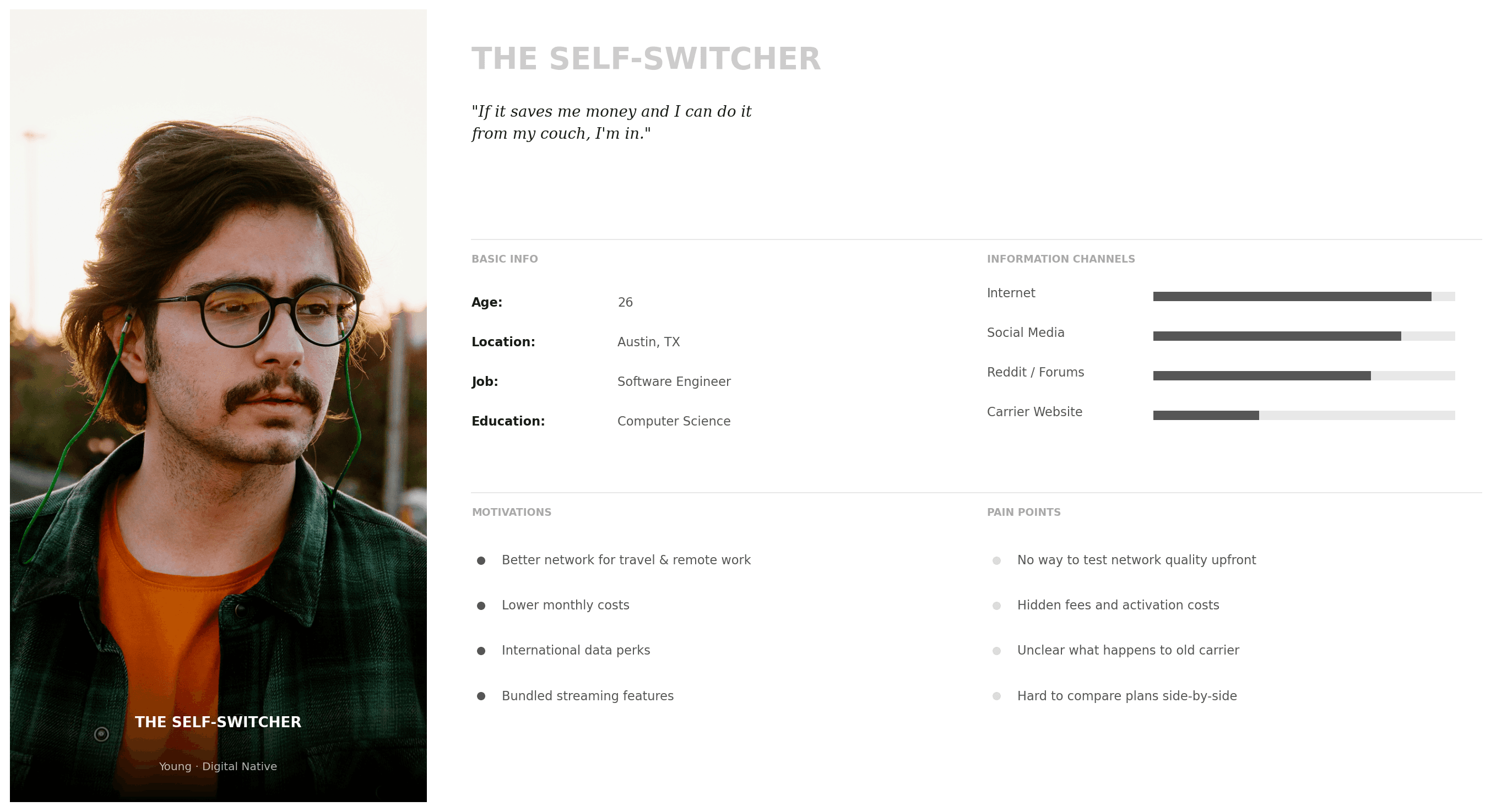
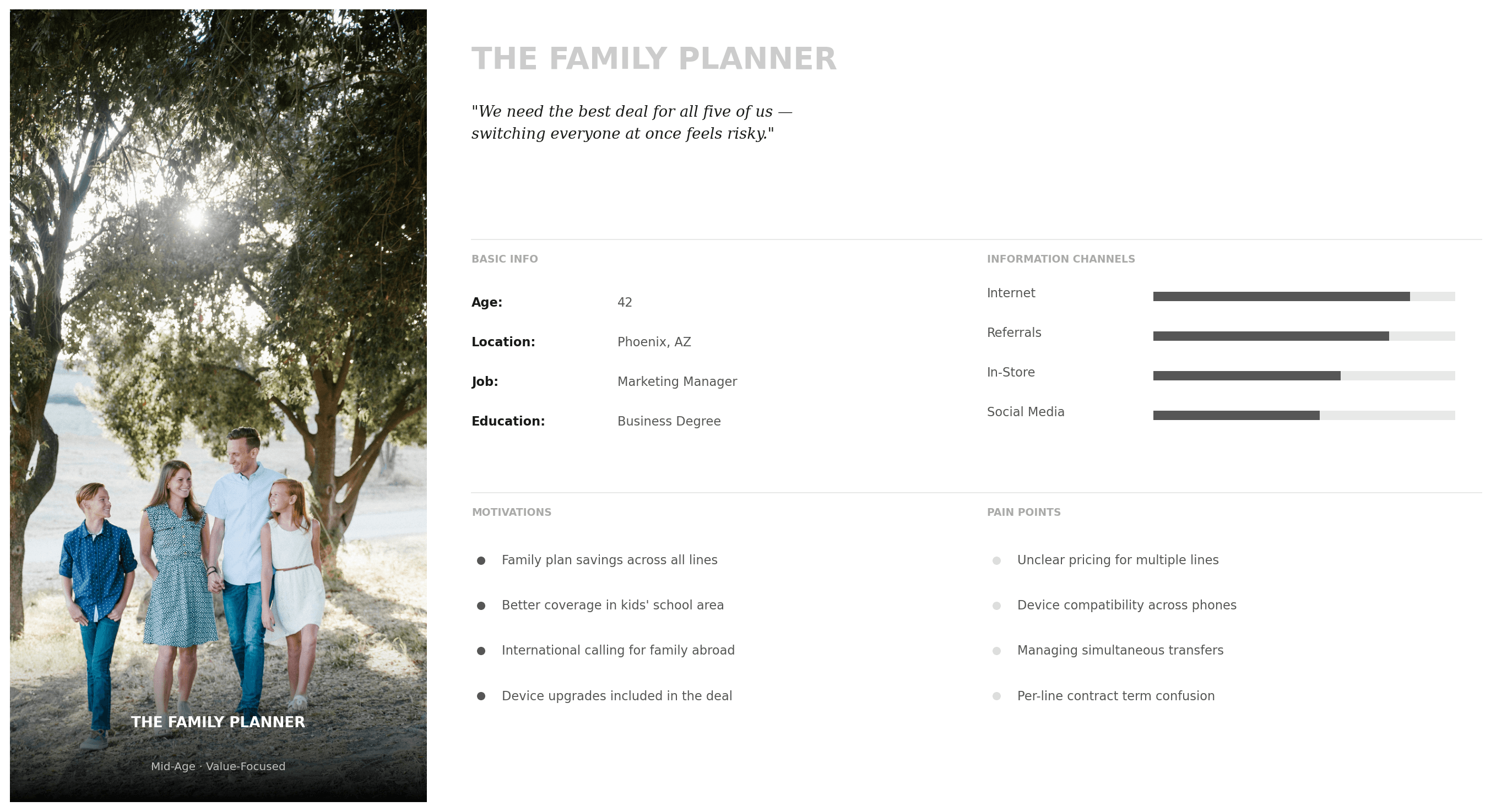
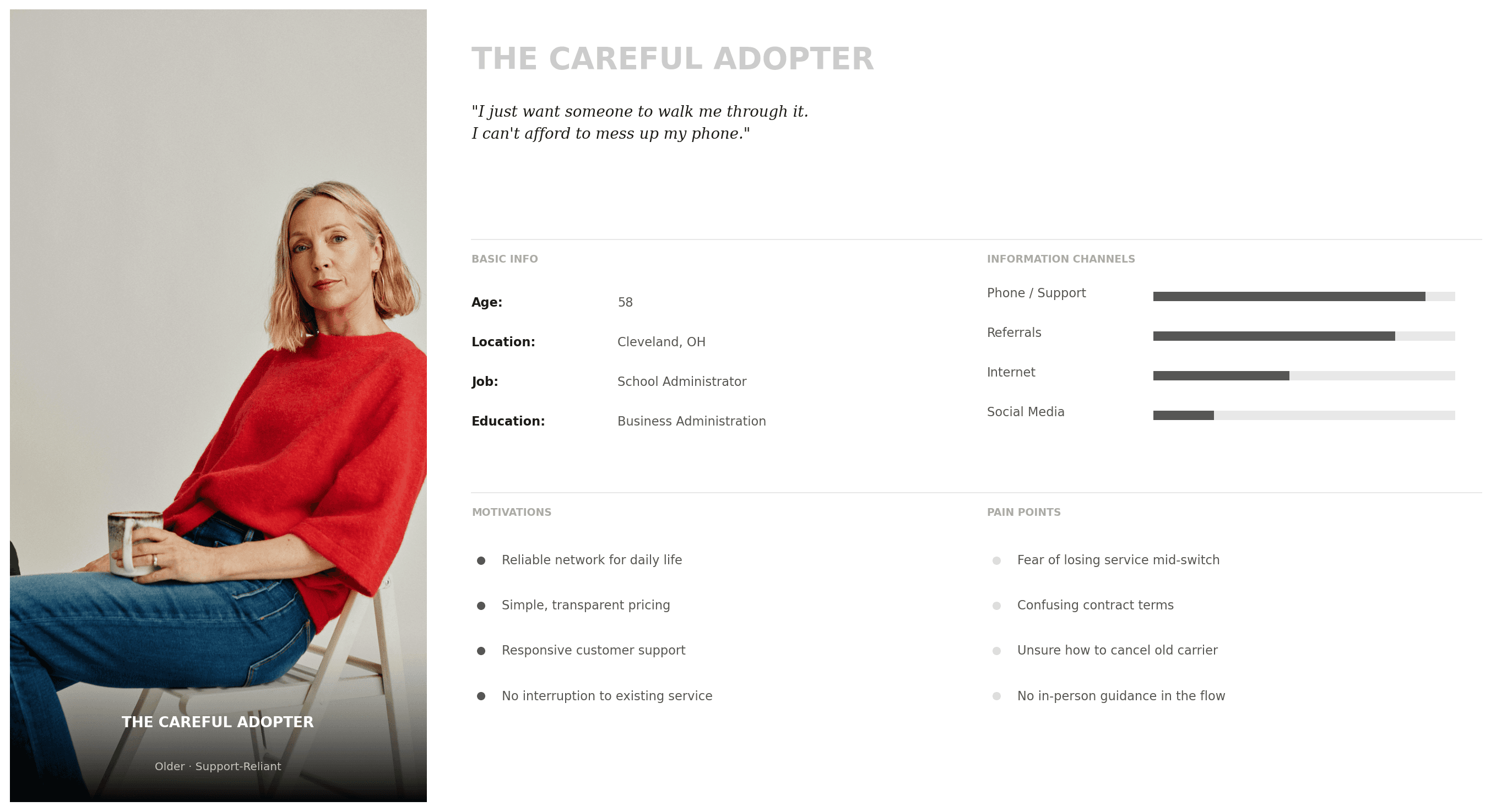
To build inclusive designs that cater to distinct user needs, we synthesized qualitative user interviews and quantitative survey data from our initial UX research into three dynamic behavioral personas. Rather than relying on superficial demographics, these personas served as realistic composites of the real users we interviewed, capturing their technical aptitude, setup anxieties, and specific motivations around the eSIM onboarding lifecycle.
Main takeaways
Here are the key insights and concerns raised by participants during our user research sessions.
The Power of Family Consultation & Offers
Switching carriers is a major commitment. Most participants need to consult with a partner, family members, or friends first. For this reason, they want a way to easily save or return to the ad later. Participants are actively questioning the nature of the partnership between T-Mobile and Meta that enabled this promotion, specifically wondering if this deal is a Facebook exclusive or if the same exact offer is available through T-Mobile’s standard retail and digital channels.
Perceived Value of Family Plans
Every participant operated under the assumption that family plans are inherently more cost-effective per person than individual plans. Users are actively looking for a complete, centralized breakdown of all ongoing costs and specific contract details, while wanting clear direction on exactly where and how to contact customer support if they have questions.
Phone Upgrade and Financing Habits
Many users prefer financing their phones by rolling the cost directly into their monthly bill, typically repeating this cycle to upgrade their device every 2 to 3 years.
Anxiety Over Carrier Off-boarding
A primary concern for users is the mechanics of leaving their old provider. They are unclear on whether they must manually cancel their existing service or if T-Mobile will handle the transition for them.
Revising the design
We translated our users’ primary concerns into a core problem statement, which directly guided the design of our solution.
Problem
Users refused to commit to a trial without upfront visibility into the long-term pricing and plans they might potentially buy, while also feeling highly anxious about how the transition would affect their device compatibilities, contracts, and multi-line family plans. Furthermore, because the trial was launched via a transient Facebook feed ad, those who wanted to pause and exit the app to conduct external validation research were terrified of losing the page, leaving them with no clear path to return and resume their application.
Solution
To remedy this, we introduced dedicated plan comparison pages that allowed users to easily access upfront pricing and dig into the specific details of their options. We also designed a reminder feature that empowered users to schedule a follow-up, sending them a timely push notification with a direct link so they could effortlessly return to the flow and resume their application.


Compare plans
Plan details
Combined trial + plan
Set a reminder
Video Alternative 1 - Carousel


Video Alternative 2 - One Pager

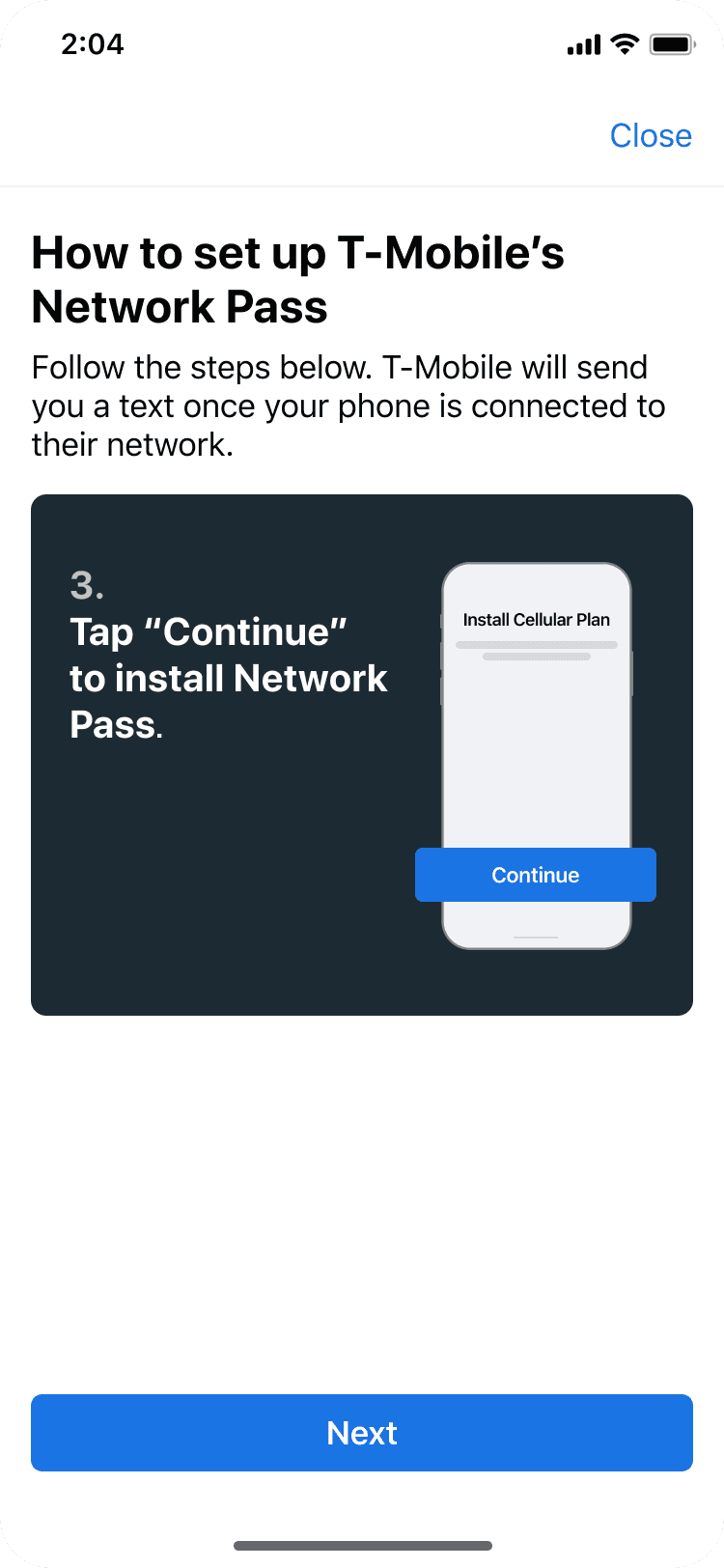
Despite its simplicity, 6 of the participants actually performed better with the plain, single-page design than with the carousel or video. It allowed them to easily take a screenshot for quick reference later when setting up their eSIM.
Results
Business Impact
Following improvements to the eSIM flow, we introduced a “direct switch” variant that allows users to switch directly to a new plan as an alternative to the 3-month trial. The resulting stats combine the direct switch and trial T-Mobile eSIM campaigns.
51%
Reduced customer acquisition cost
$1.25M
In additional partner ad spend
70%
Revenue Growth
Next Steps
• We aim to develop a ‘travel’ eSIM campaign targeting frequent flyers between the US and Europe. Mirroring the framework of our ‘direct switch’ campaign, this initiative promotes tailored eSIM data packages to capture consistent international roaming traffic and unlock additional revenue streams.
• We also set out to integrate our ‘direct switch’ framework with multi-line family plans. By streamlining the simultaneous activation of multiple eSIMs, our goal is to seamlessly transition entire households at once, capturing a massive and highly lucrative segment of the market.